Couch Speedway

1–4 players. One couch.

Arcade speedway racing for the Amiga 1200. Play it right now in your browser or put it on real hardware.

Amiga 1200 emulator

Play in your browser

Nothing to install – the real game from the floppy on an emulated Amiga.

Controls: ← → steer, ↑ ↓ menu, Enter select, Esc back. The keyboard works like on a real Amiga. A gamepad or USB joystick works as JOY 1. Click the emulator window if there is no sound.

game version: v0.99.13 (71f0b49) from 14/11/2026

Buy me a coffee
views: –

On the track

Real speedway in 2 MB

15 heats, 1–4 players around one Amiga, with bots on four levels – from Junior to Master – in the empty seats. You only have left and right – the throttle is always wide open.

Under the lights

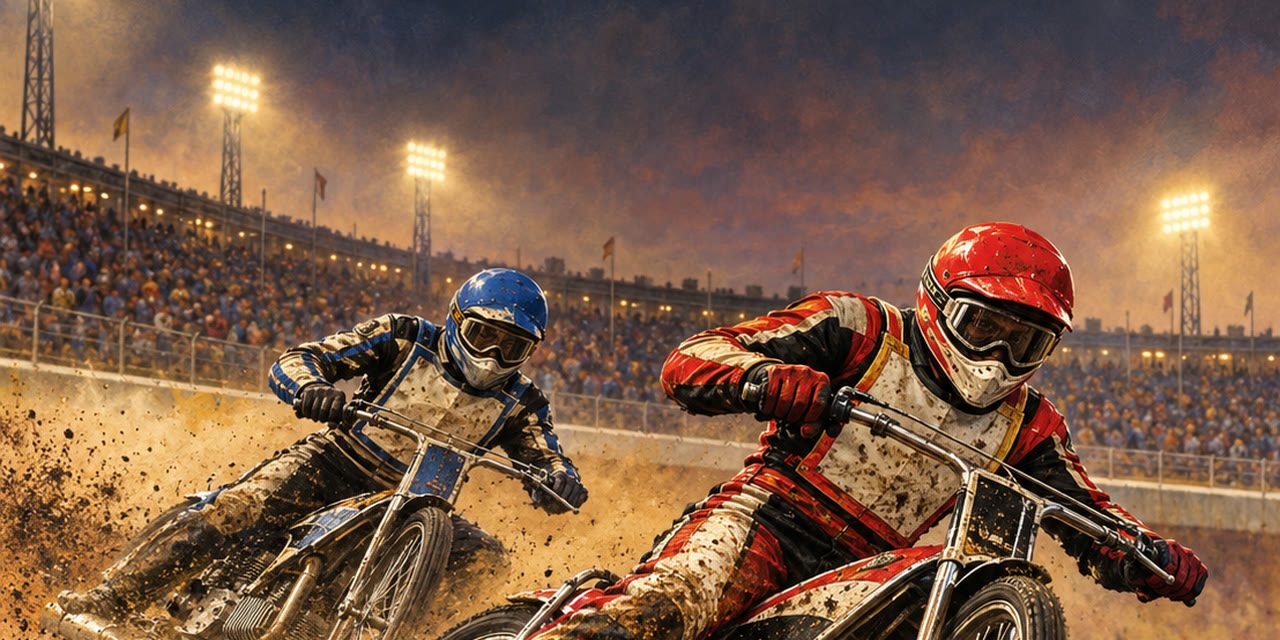
Night meetings under the floodlights – or in daylight, if you prefer.
Tape!

You go when the tape goes up. Too early – a warning; the second time, exclusion.

Dirt in your face

The track wears in heat by heat, and the riders behind eat the roost.

Rain

A wet track changes its grip heat by heat.

Falls

Red flag, the fallen rider is excluded and the heat is rerun without that rider.

Photo finish

Sometimes a few pixels decide who wins.

Engine failures

The bike can let you down at the worst possible moment.
Matches and championships

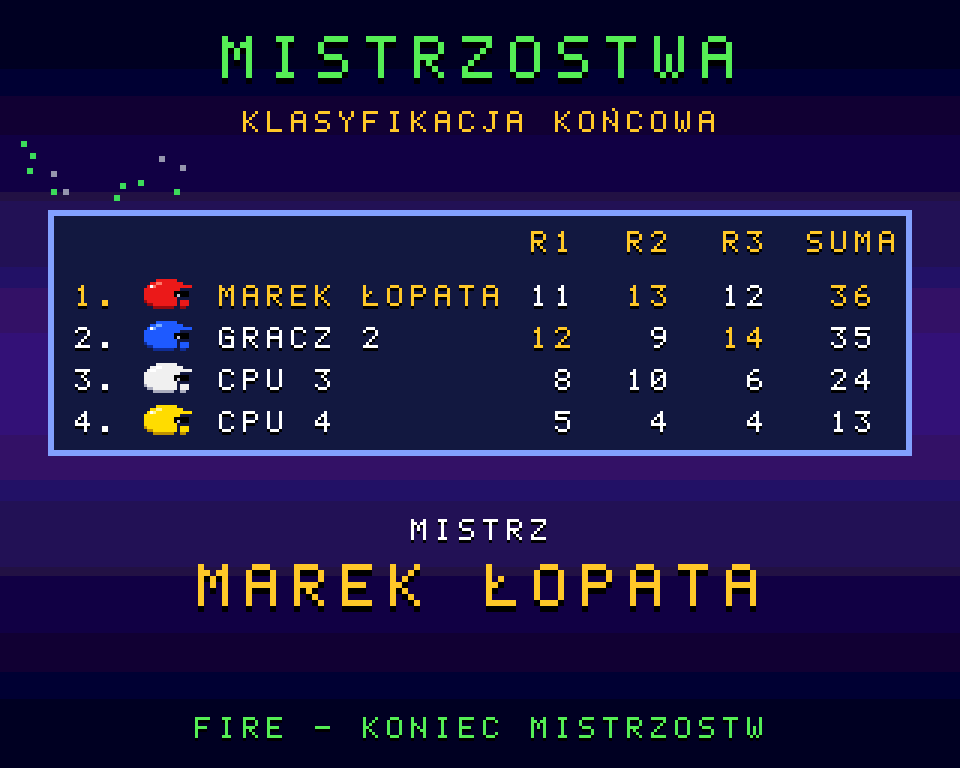
A tournament, an Ekstraliga-style match or a championship like the Polish final.

Real rules, arcade pace

The game follows the Polish speedway (PZM) rules: 4 laps, 3-2-1-0 points, tape starts, flags, track grading breaks, team matches under the Ekstraliga rules and a championship like the Polish final. Where the rulebook would spoil the couch fun, it is simplified on purpose – e.g. a team is a pair, the first touch of the tape is only a warning, and after the winner the rest have 15 s to finish.

Under the hood

Made for the love of games

Written from scratch in C for a 1992 Amiga.

50 fpson a stock Amiga 1200, no accelerator (measured in a cycle-exact emulator)
2 MBChip RAM – no Fast RAM needed
14 MHz68020 CPU and the AGA chipset
0game libraries – the game does all its graphics and sound itself

AI

Claude (Anthropic) wrote the code, tools, optimisation, docs and this website, and ChatGPT (GPT-6 Astra) helped with graphics and sounds.

Modern tooling

Graphics go through a Python asset pipeline, a tournament simulator runs the same logic as the game, tests watch every frame, and the trailer was rendered from the real game code.

Tech stack

Game

  • Cabout 9,300 lines, Polish and English builds from one code base
  • Bebbo GCCthe m68k-amigaos-gcc compiler for the 68020, NDK 3.9
  • AGAdirect control of the Copper, Blitter, sprites and Paula
  • AmigaOS 3.xboots from floppy or hard drive, Workbench icons included

Tools

  • Python 3 + numpygraphics for AGA palettes, font, sounds, data compression
  • Own ADF and iconsfloppies and Workbench icons built by scripts
  • ADPCM / PCMmenu music streamed through Paula DMA
  • ffmpegtrailer assembled from frames rendered by the game code

Testing

  • Game code on PCtournament simulator, tests, screenshots and trailer from the same logic
  • Clang (ziglang)code checks for the 68020, Polish and English
  • ASan + UBSancatch memory bugs before they reach the Amiga
  • WinUAEcycle-exact mode to measure 50 fps; plus FS-UAE and THEA500 Mini

AI

  • Claude (Anthropic)game code, tools, optimisation, docs and this website
  • ChatGPT (GPT-6 Astra)help with graphics and sounds
  • ~1.94 billion tokens

Download

Play it on your Amiga

Pick what you play on – we will take it from there.

  1. Download the ADF floppyEnglish or Polish – it is the same game.
  2. Write it to a floppy or copy it to a USB stick for a GotekA real 3.5" floppy can be written with e.g. ADF Copy. A Gotek (an electronic floppy drive) reads the ADF file straight from the USB stick.
  3. Boot the Amiga with the floppy in DF0:The game starts by itself, no Workbench needed.

No Amiga? Play in your browser.

Prefer itch.io? You can download the game there for free too – and support it with any amount.

Download / support on itch.io ↗

Requirements: an AGA Amiga, 68020, 2 MB Chip RAM, Kickstart 3.x – no Fast RAM needed.

Runs on the Amiga 1200 (also without Fast RAM), with an accelerator, on the Amiga 4000 and other AGA machines (Kickstart 3.0–3.2) and in WinUAE, FS-UAE and EmulatorJS. Tested on THEA500 Mini too.

The game is free for private use; all rights to the code and graphics are reserved.

Changelog

What's new

The game keeps growing. Click a version to see what changed.

0.99.1314/11/2026
  • A new, easiest bot level: JUNIOR – for your first evenings with the game (after a player on itch.io said even the Rookie is too hard). The Junior has a slower bike (95% speed), rides wider than the Rookie on a slowly wandering line, reacts at the tape even later (320–560 ms) and every now and then lays the bike down far too hard. In the simulator the Rookie wins about 19 out of 20 duels against the Junior, who finishes on average about 2 seconds behind – beatable on your very first evening. The Junior is first in the list of levels (on the riders screen and in the practice line-up: CPU JUNIOR). The Rookie rides exactly as before (the Professional and the Master: see below), and saved settings keep the same levels.
  • Easier bots out of the box: on the first start (no settings.dat file) with one player the bots are JUNIOR, ROOKIE and PROFESSIONAL – previously PROFESSIONAL, MASTER and ROOKIE. If you have played before, your saved levels stay as they were.
  • The Professional and the Master are a touch weaker: their bikes have 99% speed (previously 100%), so they are a little easier to stay with on the straights. Their line, start and cornering are unchanged, and so is the order of levels: in the simulator the Professional beats the Rookie in 3 out of 4 duels (previously 4 out of 5).
0.99.1212/11/2026
  • Start lights under the referee's tower: the pair of lights in the bottom bar (and the heat fast-forward “>>” in their place) now sits exactly under the referee's tower on the start line – in the tournament, the team match and practice (it used to be 17 px to the right, 21 px in a match).
  • Watering in the break no longer makes the track wet: after heats 4, 7, 10 and 13 a dry track is only sprinkled against dust – it stays DRY, gets a little darker, grips slightly less by the kerb and dries out again during the next heat. Watering used to make the track as wet as after rain. A damp or wet track is still only graded, and rain is unchanged.
0.99.1125/10/2026
  • Practice with rivals: instead of just the starting gate the practice settings have four rows GATE A–D – each can be NONE, PLAYER 1–4 (name and control from the riders screen, so you can practise with a friend) or a CPU rider with a skill level (ROOKIE, PRO, MASTER). By default only PLAYER 1 rides, from gate A. Laps are still unlimited, the infield times are the first player's; a tape touch or a fall restarts everyone from the tape. The line-up is saved with the other settings.
  • Practice fix for gates B–D: the lap stopwatch did not start and there was no engine sound at the tape (the game used the bike from gate A).
  • New logo on the title screen: the COUCH SPEEDWAY lettering is now slanted chrome – silver COUCH above gold SPEEDWAY, with a dark outline, a bevel and a semi-transparent shadow on the illustration (typeface Exo 2 Black Italic, SIL OFL licence). "PRESS FIRE" and "LOADING..." sit on a dark, semi-transparent plate with a gold frame; PRESS FIRE blinks as before. The illustration and the menu are unchanged.
0.99.120/10/2026
  • A crowd ovation instead of noise: the crowd is now a roaring crowd (about 90 voices: “aaa”, “ooo”, “eee”) and applause with stadium reverb, a seamless 4 s loop – previously band-limited noise that sounded like wind. All synthesised (tools/genaudio.py).
  • Higher revs at the tape: while you hold a direction before the start the engine sounds high and steady (throttle open, clutch in); without holding it is lower, with throttle blips. A wheel spinning in place after a late release howls even higher.
  • Smoother heats when overtaking: the helmets in the bottom bar (and the heat score digits in a match) are drawn from prepared bytes and only where the rider changed – previously every change of the running order cost several milliseconds of pixel-by-pixel drawing and the bikes stuttered.
  • TRACK instead of OVAL: the screens label the surface as “TRACK: WET” (previously “OVAL: WET”), and the records no longer show the name of the only track.
  • Infield scoreboard: in a team match a big electronic scoreboard in the middle of the oval, in place of the COUCH SPEEDWAY lettering, shows the match score (gold digits with bars in the teams' helmet colours) – updated after every heat.
  • Helmets instead of coloured boxes: a small side-view speedway helmet shows each rider's colour in the menus, the race programme, the results, at the end of a match and when entering a record. When picking gates for the nominated heats a taken gate shows the helmet of the rider who picked it, and a free one just its letter (the helmet does not depend on the gate, so the old gate colours were misleading).
  • Team names in a match: instead of the “home” and “away” teams there are TEAM 1 and TEAM 2 – you can type the names on the riders screen (like riders' names, also with the joystick and Polish letters) and the game remembers them. The screen shows who is in which team: riders 1–2 and 3–4 under the team name, and every rider has his helmet instead of a number.
  • Live match score: in a match the bottom bar shows in the middle, under the helmets, the heat score from the current running order (e.g. 4:2); after the heat the results panel shows the team names.
  • Roost stays on the track: clods from the rear wheel settle as loose dirt – the surface gets lighter, and there the track turns soft and heavy (less grip, the bike slows down). The racing line stays dark and packed because the wheels sweep the loose dirt off it; it collects on the outside and by the fence, and the grader spreads it during a track break.
  • Event type in the title: the riders screen is titled INDIVIDUAL, TEAM MATCH or CHAMPIONSHIP instead of "EVENT", matching the option in the settings, where the event type is now at the top of the list.
  • Practice: falls and starting gate to choose – the practice settings have FALLS: YES/NO and GATE: A–D (saved with the other settings).
  • Helmets instead of squares: the riders' order in the bar at the bottom is shown with side-view speedway helmets (dome, peak, goggles) in the riders' colours.
  • New menu music – "Cold Grid": cool synth-pop (130 BPM) as a ProTracker module that plays from an interrupt, independently of the game loop, so longer menu frames (e.g. after FIRE) don't interrupt it. It takes 24 KiB instead of 208 KiB – about 200 KiB less Chip RAM. The track is entirely generated (tools/genmod.py), and the game plays it with ptplayer by Frank Wille (public domain). The old PCM tracks can still be chosen in build.cfg.
  • "3" and "2" boards instead of the lap counter: as at the stadium, the referee shows the "3" board after the leader's 1st lap and "2" after the 2nd; the "1/4" counter is gone from the bar (practice keeps the lap number).
  • A continuous white inner line – like the chalk line on a real track (previously a red-and-white striped kerb); also on the oval diagram in the manual.
0.9919/10/2026
  • The start follows the Polish speedway rules: the green light means get ready, and the start signal is the release of the tapes – let go when the tape goes up. The red lights flash only when a heat is stopped (a tape offence, a fall).
  • Team match: the gate set for heats 14 and 15 is picked after heat 13 by the losing team (the away team on a draw) – as in the Ekstraliga rules.
  • Championship like the 2026 Polish Individual Championship finals: a tie for places 1–3 after the last round is decided by a run-off for the medal, other ties by the number of first, second, third and fourth places in the rounds (previously: round wins, then the place in the last round).
  • A lapped rider is excluded: when a rival laps them by a full lap, the referee shows the black flag and the rider rides off onto the infield (“X”).
  • Track breaks as in the 2026 Ekstraliga rules: after heats 4, 7, 10 and 13 (0.98 had 4, 7, 11, 14 – from outdated rules).
  • The game website instead of GitHub: the credits screen, the package and the manual show the game website b4rtiga.pl/couch-speedway. From this version the game is free for private use, and the rights to the code and graphics are reserved (versions up to 0.98 were released under the MIT licence).
  • A start without the buzzer: on green you hear the starting gate releasing the tape: a quick rattle of the mechanism and the tape flapping at the top (synthesised from measurements of the real sound).
  • Four engines at the tape: while the riders wait for the start, the crowd goes quiet and the crowd and effects channels briefly play the engines of gates B and C – you hear all four.
  • You hear your own engine: in a heat the player closest to the front and their nearest rival are heard (with no players on track – the leader and the second), and each engine sits in the left or right speaker depending on where the bike is on the screen.
  • Every rider has their own engine pitch, so two engines at the same revs no longer beat.
  • A more detailed engine: the sample has twice the detail (96 samples per firing), and Paula plays it at about 9–10 kHz instead of 4.7 kHz.
  • New player effects: gravel hiss in a hard slide and a dull thud when scraping the fence; the more important sounds (the start, the crowd's cheer and groan) take priority.
  • Fast forward appears only after the start lights go out and not during a fall (the referee stops the heat anyway) – in the rerun without the fallen player it does.
  • Text centred to the pixel: strings with an odd number of characters used to sit 4 px left of centre.
0.9817/10/2026
  • Fast forward: when no human player is still riding (a defect, a fall or an exclusion), FIRE fast-forwards the rest of the heat – no more waiting for the bots. A sign on the infield and a >> icon in the HUD show it (green while fast-forwarding); another FIRE goes back to normal speed. Several times faster, up to 12 times on fast Amigas.
  • Track breaks as in the rules: after heats 4, 7, 11 and 14 (was 13) – like the technical breaks of a league match.
  • Watering only a dry track: a damp or wet track is only graded in the break (two tractors with drags, no water bowser; a “GRADING TRACK” sign) – watering is against dust, as at real meetings, and there is no break in the rain. The “SLICK SURFACE!” line is gone from the break sign.
  • Less engine beating: the two audible engines played the same sample at almost the same revs and beat against each other in the speaker (the volume pulsed a few times a second). The second engine now plays about 11% lower.
  • Smooth name editing: while editing a rider name on the event screen, its row was redrawn every frame, even with no key pressed – now only on a change and on the cursor blink. On the records name-entry screen the cursor and letters redraw only the name row, not the whole screen. The music no longer stutters.

Contact

If you need anything, get in touch by e-mail.

✉ Send an e-mail